If you'd told me in 1997 that one day Edinburgh GPs would be recommending Tai Chi to their patients instead of (or alongside) medication, I'd have believed you — because I'd already been watching it change people's lives for years. What I couldn't have predicted was the scale of the research that would eventually back it up. Hundreds of clinical studies. Meta-analyses. Randomised controlled trials. All pointing in the same direction.
This article gathers the most significant findings into one place — seven things that regular Tai Chi practice demonstrably, measurably does to the human body — with the specific numbers where the research is clearest. It's the overview I wish existed when I first started trying to explain to people why this gentle, ancient practice was worth their time.
▶
LFA Tai Chi Edinburgh — See It In Action
Watch John teach a class — this is what you're reading about
LFA Tai Chi Edinburgh — gentle, flowing, and available in-person across Edinburgh or live on Zoom
45%
Reduction in fall risk
Across multiple studies in older adults
23%
Lower cortisol levels
Measured in regular practitioners
50%
Reduction in anxiety scores
After 10 weeks of regular practice
The 7 Benefits At A Glance
- Balance and fall prevention — up to 45% fall risk reduction, the strongest evidence base of any exercise for older adults
- Flexibility and functional strength — 17% flexibility improvement in 12 weeks, without a single joint impact
- Chronic pain management — more effective than standard physical therapy for knee osteoarthritis in one landmark trial
- Sleep quality — 48% improvement in sleep quality scores in regular practitioners
- Stress and anxiety reduction — 23% reduction in cortisol, 50% drop in anxiety scores after 10 weeks
- Cognitive function — measurable improvements in memory, attention, and executive function
- Mood and emotional wellbeing — significant reductions in depression symptoms alongside improved quality of life
The 7 Benefits:
What The Research Shows
1
Balance & Fall Prevention
One in four adults over 65 falls each year in the UK — and falling is the leading cause of injury-related death in this age group. Tai Chi's slow, weight-shifting movements train the proprioceptive system (the body's sense of its own position in space) more effectively than almost any other exercise. Multiple trials show fall risk reduced by 45% with regular practice. This is the most consistently replicated finding in Tai Chi research, and the reason NHS physiotherapists across Edinburgh increasingly recommend it specifically — not just "exercise," but Tai Chi.
Up to 45% reduction in fall risk
2
Flexibility & Functional Strength
The slow pace conceals a genuine physical demand. Tai Chi's continuous movements engage the core, legs, and stabilising muscles throughout every session — building functional strength, the kind you use on stairs, uneven ground, and in any movement that requires balance alongside force. Research published in the Journal of Aging and Physical Activity found 17% improvement in flexibility and 15% improvement in muscle strength in older adults after just 12 weeks. All standing, all zero-impact. The Arthritis Foundation recommends it specifically because the movements lubricate joints without loading them.
17% flexibility gain in 12 weeks
3
Chronic Pain Management
The pain management evidence is remarkable. Research published in the New England Journal of Medicine — one of medicine's most prestigious journals — found that Tai Chi for knee osteoarthritis produced better outcomes than standard physical therapy. For back pain, fibromyalgia, and rheumatoid arthritis, the picture is similarly consistent. Tai Chi addresses pain through multiple pathways simultaneously: improving joint mobility, strengthening the muscles that support painful joints, reducing the inflammatory markers that amplify pain signals, and lowering the stress hormones that make pain feel worse. The result is pain relief that is genuinely systemic rather than localised.
Outperformed physical therapy for knee OA
4
Sleep Quality
A meta-analysis of randomised controlled trials found 48% improvement in sleep quality scores in regular Tai Chi practitioners compared to controls. The mechanisms are well understood: cortisol reduction removes the primary hormonal barrier to sleep onset; the deep physical relaxation produced by practice releases the chronic muscle tension that keeps sleep shallow; and the meditative attention of Tai Chi trains the mind to disengage — addressing the racing mind at bedtime more effectively than most conventional mindfulness apps. For older adults, Tai Chi consistently reduces nighttime waking and increases the proportion of time spent in deeper sleep stages.
48% improvement in sleep quality scores
5
Stress & Anxiety Reduction
This is where Tai Chi's "moving meditation" quality pays its most dramatic dividends. The synchronised breath-movement practice activates the vagus nerve and parasympathetic nervous system within minutes, measurably lowering cortisol — the primary stress hormone — by an average of 23% in regular practitioners. A study of 60 adults with moderate anxiety found a 50% reduction in anxiety scores after just 10 weeks of practice. The effect is both immediate (each session produces measurable calm that lasts several hours) and cumulative (regular practice lowers the baseline stress level over weeks and months). For Edinburgh professionals managing the particular pressures of city professional life, this is often the most life-changing benefit of all.
50% drop in anxiety scores in 10 weeks
6
Cognitive Function
Tai Chi provides what researchers call "cognitive load" — it demands the brain coordinate movement, spatial awareness, breathing, sequence memory, and present-moment attention simultaneously. This multi-network engagement is essentially cross-training for the brain. Studies have shown significant improvements in memory, attention, processing speed, and executive function in regular practitioners. For older adults with mild cognitive impairment, one study found Tai Chi improved cognitive performance more than conventional exercise. The implications for dementia prevention — while not yet definitive — are actively being researched at several major universities, with early results suggesting a meaningful neuroprotective effect.
Outperformed conventional exercise for mild cognitive impairment
7
Mood & Emotional Wellbeing
Research in the Journal of Alternative and Complementary Medicine found significant reductions in depression symptoms and meaningful improvement in overall quality of life in regular Tai Chi practitioners. The mechanisms overlap with the stress and anxiety findings — cortisol reduction, increased endorphins, improved sleep — but the social dimension matters too. Attending a regular Tai Chi class provides community and belonging that many Edinburgh adults genuinely lack. Students who've been attending for months describe the class not as exercise they do but as a relationship they have — with the practice, with John, and with the group. That social connection is itself a robust mood protector.
Significant reduction in depression symptoms

LFA Tai Chi Edinburgh — the practice is deceptively demanding: slow enough to be safe, purposeful enough to produce real results
When my rheumatologist suggested Tai Chi I was sceptical. I'd been managing rheumatoid arthritis for twelve years and nothing gentle had ever made a real difference. Six months later my inflammation markers are the lowest they've been in a decade. I'm telling everyone.
— Linda, 59 · rheumatoid arthritis, Edinburgh
Busting The Myths That
Keep People Away
Every week I speak to people who were curious about Tai Chi but talked themselves out of trying it based on misconceptions. Here are the most common ones — and the honest truth behind each:
It's too slow to be real exercise
The slow pace makes it more demanding in certain respects, not less. Maintaining continuous semi-squat positions while coordinating arm movements for 45 minutes engages more muscle fibres than you'd expect. The absence of momentum means every movement is done entirely by your own muscular control.
You need to be flexible to start
Flexibility is a result of Tai Chi practice, not a prerequisite for it. The movements are designed to work within your current range and gradually expand it. Many of our Edinburgh students have had no meaningful flexibility when they joined and gained significant range of motion within the first few months.
It's only for elderly people
While Tai Chi's benefits for older adults are particularly well documented, people at every age and fitness level attend LFA Tai Chi Edinburgh classes — from professionals in their 30s managing work stress to athletes using it for balance and recovery. The practice meets you wherever you are.
You need to embrace Eastern philosophy to benefit
The philosophical roots of Tai Chi are interesting but entirely optional. The physiological mechanisms behind the benefits — parasympathetic nervous system activation, lymphatic stimulation, cortisol reduction — work regardless of whether you've read a word of Taoist philosophy. You can practise Tai Chi as pure movement science if that suits you better.
10 minutes isn't enough to make a difference
Research specifically on short-duration daily practice — including a Harvard study on 12-minute sessions — shows meaningful health benefits from brief but consistent practice. The key is regularity. Daily practice of 10 minutes produces better outcomes than a weekly 70-minute session because the body's stress-response systems respond to regularity of stimulation, not just total dose.
Ready to experience it yourself?
Your first class at LFA Tai Chi Edinburgh is completely free. Call or text John on 07450-979-625 — he'll find the right session for you.
Book Free Class →
Getting Started In Edinburgh:
What You Actually Need To Know
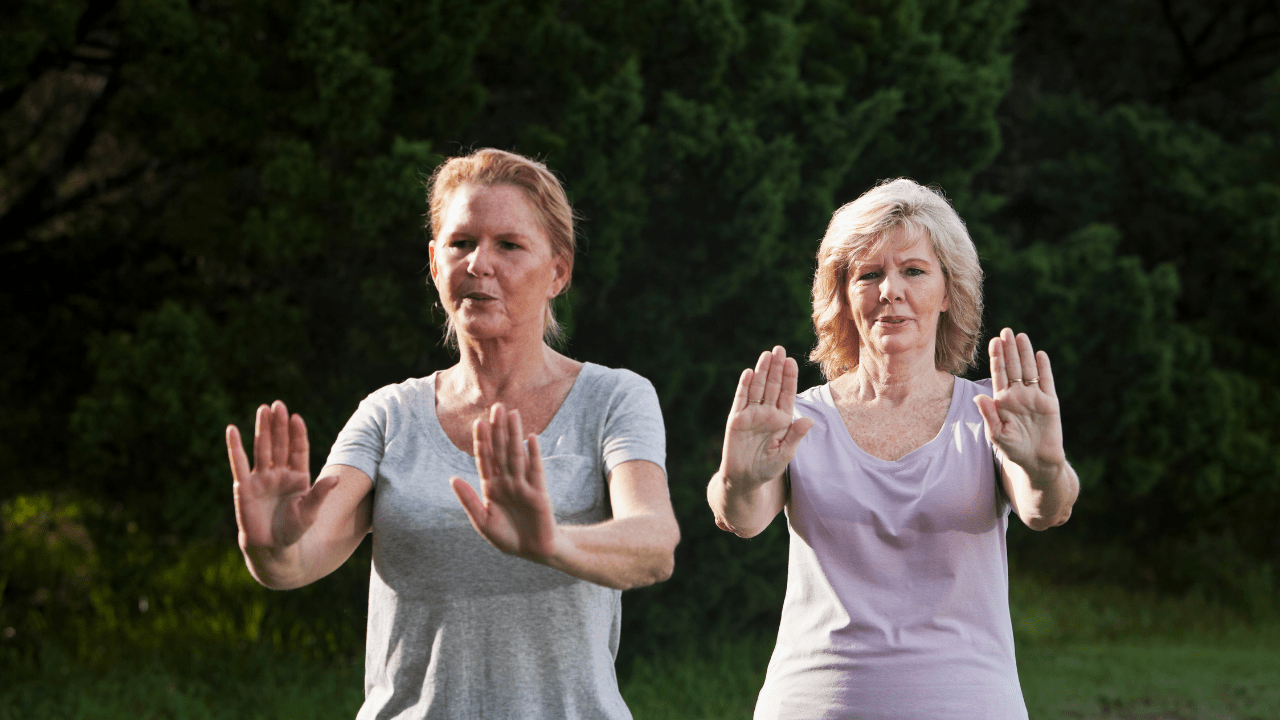
Getting started requires less than you think — comfortable clothing, flat shoes, and enough space to extend your arms
What You Need
Comfortable, loose-fitting clothing. Flat shoes with good grip, or bare feet for Zoom classes. Enough floor space to extend your arms — roughly 1.5 metres. Nothing else. No mat, no equipment, no special clothing, no fitness baseline.
What To Expect In Your First Session
Your first class begins with standing warm-up exercises and basic breathing. John introduces two or three fundamental movements, breaks each one into small steps, and repeats them enough times that they begin to feel familiar. Nobody expects you to remember everything. The goal of your first session is to experience the practice, not master it.
Most people notice something in the hour after their first class — a physical calmness, a slight heaviness and looseness in the body, a quieter mind. That's the parasympathetic effect working. It's immediate, even before you've learned anything properly.
In-Person or Zoom?
LFA Tai Chi Edinburgh runs classes in-person at venues across Edinburgh and live on Zoom Monday through Friday. Both work well for beginners. Zoom classes are recorded so you can revisit sessions for home practice — from your very first class, you have proper guidance available every day between sessions.
Your First Step — Try "Lifting the Sky"
Stand with feet shoulder-width apart, knees very slightly softened. Let your arms hang. Slowly raise them out to the sides and overhead, as if lifting a large beach ball — taking a slow inhale as you rise. Turn your palms downward and slowly lower your arms back to your sides as you exhale. Repeat three times. Notice what you feel.
That's Tai Chi. Slow, purposeful, coordinated with breath. Everything else is this, made more elaborate. If this feels right — it will — the door is open.
I started because my GP suggested it for my blood pressure. I stayed because it's the only hour in the week where my mind is genuinely quiet. I hadn't realised how much I needed that until I found it.
— Stuart, 54 · Edinburgh New Town
Common Questions
How quickly will I see results?
The immediate effects — a sense of physical calm and mental quiet — appear after the very first session for most people. Sleep improvements typically become noticeable within 2–4 weeks of regular practice. Measurable changes in blood pressure, balance, and inflammatory markers appear in most studies at 8–12 weeks. The benefits then compound — a year of regular practice produces significantly better results than three months, not because you're doing more, but because the cycle of improvement has had time to deepen.
How is LFA (Lee Style) different from other Tai Chi styles?
LFA (Lee Style) was developed specifically as a health system rooted in Traditional Chinese Medicine, rather than as a martial art that was later adapted for health purposes. This means every movement has a deliberate therapeutic intention. The stances are shorter than Yang or Chen styles, making it gentler on the knees and more immediately accessible for people with joint problems. It is the style John has taught in Edinburgh for 28 years.
Can I do Tai Chi if I'm managing a health condition?
Almost certainly yes — and for many health conditions, Tai Chi is specifically recommended. Arthritis, high blood pressure, chronic pain, post-surgical recovery, balance disorders, anxiety, depression, and cardiovascular conditions have all been shown to respond well. Always consult your GP first, and tell John about your condition before your first class. He will adapt every movement appropriately and will never ask you to do anything that isn't right for your body.
What does it cost?
Your first class is completely free. After that, a 4-week block costs £24 — £6 per session. A single drop-in is £7. This makes LFA Tai Chi Edinburgh one of the most affordable qualified Tai Chi options in the city — and the Zoom format means no travel costs and sessions you can replay at home any time.
The evidence is substantial. The accessibility is genuine. The first class is free. If you've been considering Tai Chi — for your balance, your pain, your sleep, your stress, or simply because something in this article resonated — the simplest next step is a call.
Call or text John on 07450-979-625. Tell him what brought you here. He'll find the right class for you.